Our preprint Conserved genes, discordant structure: a pangenomic view of plant mitochondrial genome evolution is now out on bioRxiv.
Land plant mitochondrial genomes vary more than two orders of magnitude in size, from about 66 kb to over 19 Mb, and range from simple circles to highly complex, multipartite assemblies. We de novo assembled and annotated over 300 of them, measured their assembly graph complexity and recombination potential, and built a “hyper” pangenome spanning the land plant phylogeny.
Some highlights:
- Gene content is highly conserved, and so is gene order in mosses and liverworts. In vascular plants, synteny collapses almost entirely.
- Genome size and interspersed repeats are the strongest predictors of structural complexity.
- DNA transfer into the mitochondrion is roughly three times more frequent from the nuclear genome than from the plastid, but it does not itself drive genome expansion.
- TE’s - we found lots of evidence of TE’s in our mitochondrial genomes, but they were all non-functional even though in some lineages they had been copied in the mitochondrion post-transfer from the nucleus.
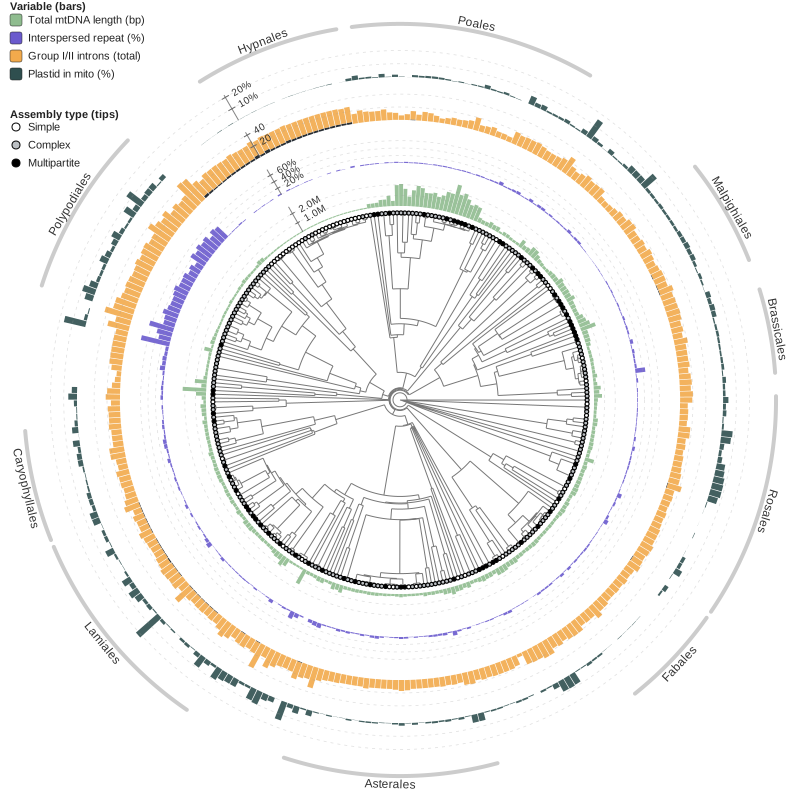
You can explore the complexity data interactively on our figures page.
This was a big collaboration with Jim Downie, Nathan Riley, Rory Craig, Lucia Campos-Dominguez, colleagues at EMBL-EBI, the Darwin Tree of Life consortium and Alex Twyford. So thanks to all the co-authors, this one has been in the pipelines for a few years!